
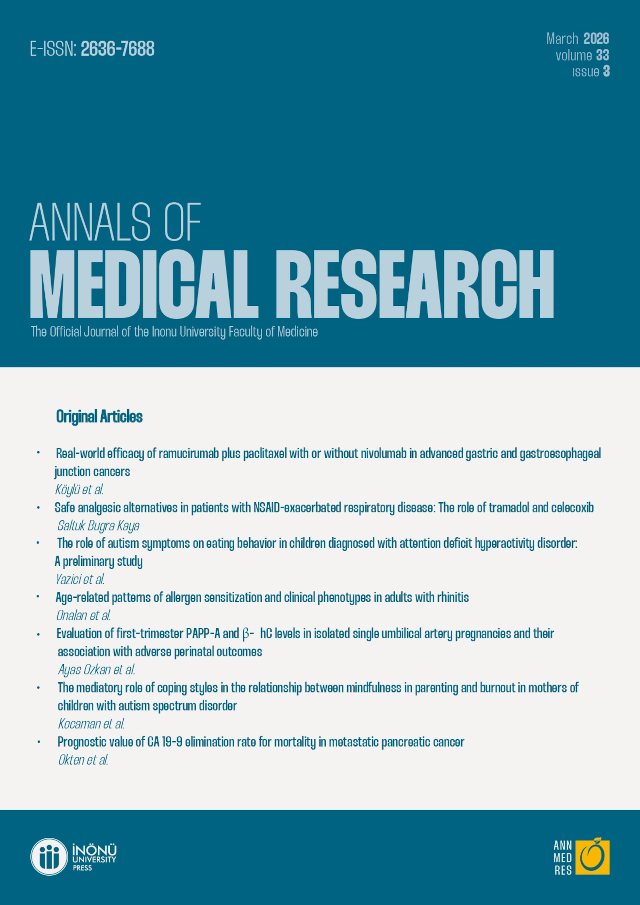
Evaluation of first-trimester PAPP-A and β-hCG levels in isolated single umbilical artery pregnancies and their association with adverse perinatal outcomes
Article Sidebar
Main Article Content
Abstract
Aim: This study aimed to evaluate the association between first-trimester biochemical markers—pregnancy-associated plasma protein A (PAPP-A) and beta-human chorionic gonadotropin (β-hCG)—and adverse perinatal outcomes in pregnancies complicated by isolated single umbilical artery (SUA).
Materials and Methods: This retrospective case-control study was conducted at a tertiary perinatology center between January 2023 and January 2025. The study group included 266 pregnant women diagnosed with isolated SUA, and the control group included 266 healthy singleton First-trimester serum PAPP-A and β-hCG MoM values were compared between groups. Composite adverse perinatal outcome (CAPO) was defined as the presence of at least one of the following: preterm birth, fetal growth restriction (FGR), oligohydramnios, polyhydramnios, intrauterine fetal demise (IUFD) or NICU admission.
Results: Although PAPP-A MoM levels were not significantly different between the SUA and control groups, PAPP-A values were significantly lower in SUA cases that developed CAPO (p<0.001). ROC analysis revealed that a PAPP-A cut-off <0.65 predicted CAPO with 2% sensitivity and 72.2% specificity (AUC=0.704, p<0.001).
Conclusion: Low first-trimester PAPP-A levels may serve as a moderate predictor of adverse perinatal outcomes in isolated SUA PAPP-A may help guide risk stratification and antenatal surveillance intensity in this β-hCG MoM levels were higher in SUA cases than controls (p<0.001), but no significant difference was found between SUA cases with and without CAPO (p>0.05).
Downloads
Article Details
Section

This work is licensed under a Creative Commons Attribution-NonCommercial-NoDerivatives 4.0 International License.
CC Attribution-NonCommercial-NoDerivatives 4.0